
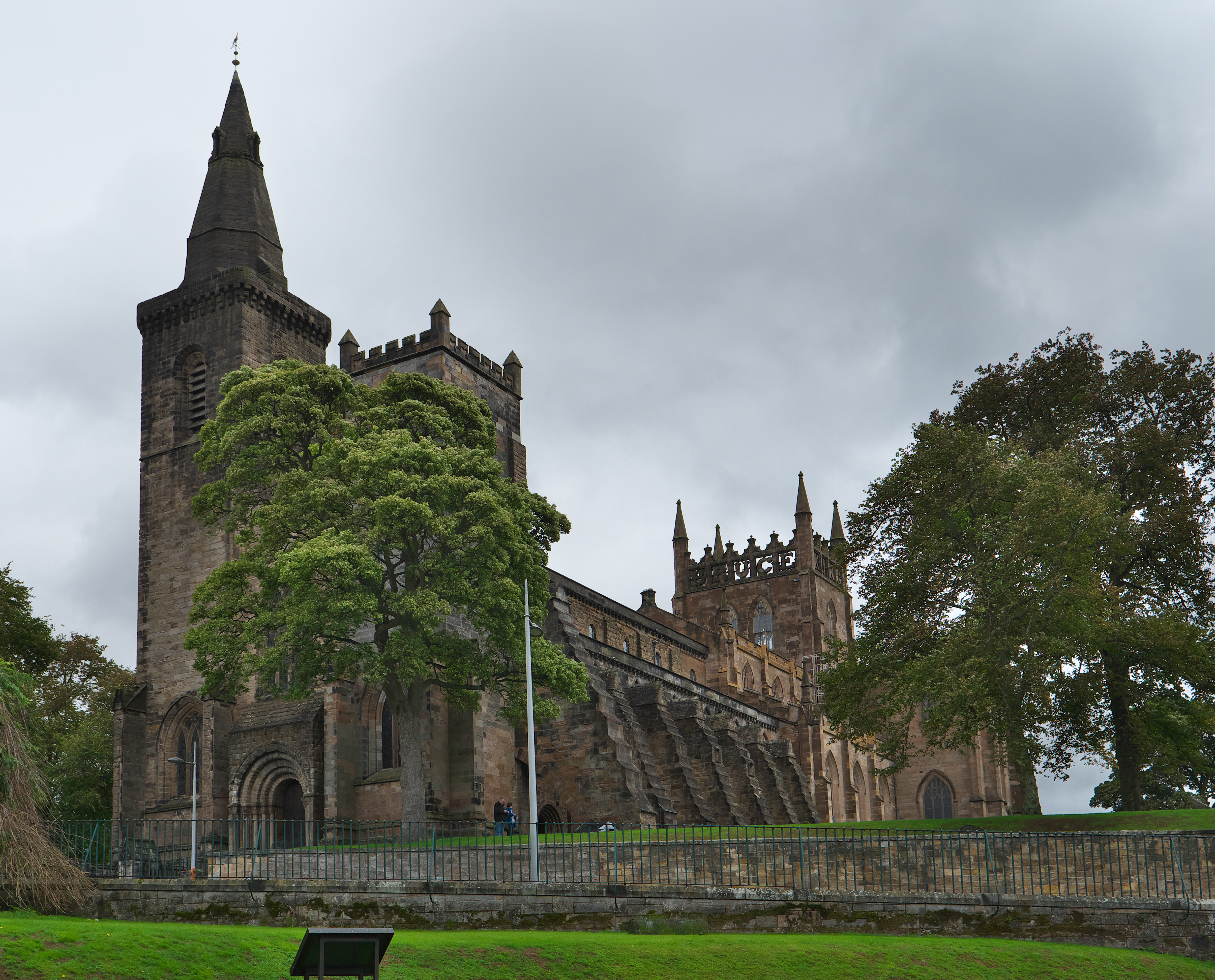
Some journeys are more than sightseeing. When I walked through the gates of Dunfermline Abbey, I wasn't just visiting one of Scotland's most historic sites — I was walking toward the tomb of my ancestor, Robert the Bruce, King of Scots. That knowledge changes everything about how you see a place. The stones feel different. The silence means more.
But this visit gave me something I hadn't expected. Not just history. Not just a tomb. A living connection — a cousin, discovered through DNA, who I was meeting for the very first time. In the town where our shared ancestor is buried. It is the kind of moment that makes you believe the past is never quite as far away as it seems.
This trip to Scotland was, in many ways, the continuation of a life's work that began with my mother. She dedicated years to researching our family's ancestry — painstakingly tracing the lines that connect us to some of the most extraordinary figures in Scottish history. She gave me this inheritance: not just the names and dates, but the hunger to know where we came from. Someday I hope to carry that work forward, to build on what she started, and eventually to help others discover their own ancestral stories the way she helped me discover mine. These blog posts are part of that journey. They are my way of beginning.
Scotland's First Capital
Before Edinburgh claimed its crown as Scotland's capital, Dunfermline was the beating heart of the nation. For centuries this was where Scottish royalty lived, worshipped, and were buried. The abbey was founded in the 11th century by King Malcolm III and his queen, the sainted Margaret — and it became the royal mausoleum of Scotland, the Westminster Abbey of its time. Fourteen Scottish kings and queens are buried within its walls.
The abbey we see today is a blend of Norman grandeur and Gothic drama — part ruin, part living church. The original Norman nave still stands, its massive columns rising in the distinctive chevron-carved style that echoes Durham Cathedral. It is one of the finest pieces of Romanesque architecture in Scotland, and standing inside it, you feel the full weight of a thousand years pressing down on you.
The Tomb of Robert the Bruce
Beneath the pulpit of the abbey church lies the tomb of Robert the Bruce — my ancestor, and the man who secured Scotland's independence from England at the Battle of Bannockburn in 1314. His tomb was discovered in 1818 during construction work, identified by the sawn-open breastbone — his heart had been removed after death, as was his wish, to be carried on crusade to the Holy Land. The heart never made it; it was brought back to Scotland and buried at Melrose Abbey. His body remained here, in Dunfermline, where it had always been.
A brass plaque marks the spot, and the words carved around the top of the tower outside announce it to the world: KING ROBERT THE BRUCE. Standing there, knowing this man is part of my own bloodline — a connection my mother spent years carefully documenting and tracing — was one of those rare travel moments that genuinely stops you in your tracks.
This is what genealogy does that no history book can. It takes the grand sweep of national history and makes it intimate. Robert the Bruce is not just a figure in a textbook for me. He is family. And standing at his tomb, I understood more clearly than ever why my mother's work matters — and why I want to continue it.
A Cousin, Found Across an Ocean
DNA genealogy has quietly revolutionised the way people discover their family history, and my visit to Dunfermline is proof of what it can lead to. Through a DNA match, I had connected with a cousin — a woman I had never met, living in Scotland, descended from the same ancient bloodline that my mother had spent her life tracing. We arranged to meet in Dunfermline, in the town where our shared ancestor is buried.
She came with her husband, and we spent time together in the shadow of the abbey that connects us both. There is something remarkable about meeting a stranger who is also, in the most fundamental biological sense, family — someone who carries the same deep strand of history in their DNA that you do, who grew up on the other side of the world from you and yet shares the same roots in this ancient Scottish soil.
This is exactly the kind of connection I hope to help other people find. My mother believed that knowing where you come from changes how you understand yourself — that ancestry is not just the past but a living, breathing thing that shapes who you are today. Meeting my cousin in Dunfermline, two women from different continents sitting together in the town of their shared ancestor, was the most powerful proof of that I have ever experienced.
Her son competes in the Highland Games — those magnificent traditional contests of strength and skill that reach back to the warrior culture of the very clans our ancestors belonged to. Tossing the caber, throwing the hammer, putting the stone — the living continuation of a tradition that connects him directly to the Scotland his ancestors fought to defend. I didn't get to see him compete on this visit, but watching the Highland Games with this family is firmly on my list for the next trip. To see that tradition carried forward by the next generation of my own extended family, in this country, would be something very special indeed.
The Palace and the Park
Adjacent to the abbey stand the ruins of Dunfermline Palace — where King Charles I was born in 1600, one of the last great moments of Dunfermline's royal story before the court moved south following the Union of the Crowns.
Pittencrieff Park, immediately beside the abbey, was gifted to the people of Dunfermline by Andrew Carnegie in 1903. It is a beautiful, generous park with gardens, a glen, and a waterfall — peaceful and entirely appropriate beside a royal burial ground.
Dunfermline is just 30 minutes by train from Edinburgh and is too often overlooked by visitors making straight for the capital. For anyone with Scottish ancestry — or anyone curious about what DNA genealogy might reveal about their own family — it is a place that rewards the journey enormously.
Some roots, it turns out, are still very much alive. And the work of finding them, of following the thread back through the centuries, is among the most meaningful things any of us can do.
If reading this has sparked your own curiosity about Scottish ancestry and genealogy, stay tuned — helping others discover their own family stories is something I hope to make a much bigger part of what I do. My mother began this work. I intend to carry it forward.