
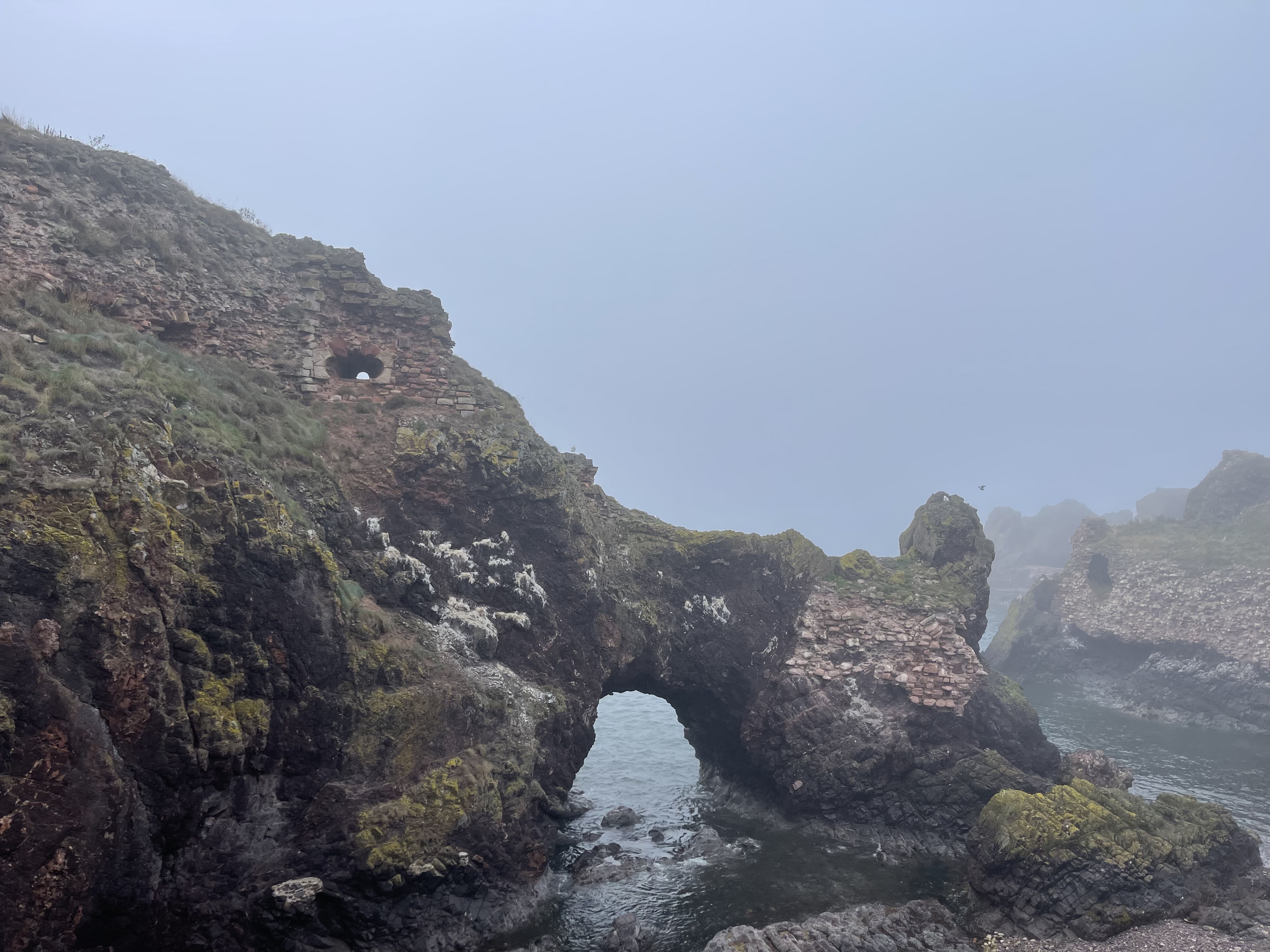
Dunbar does not shout. It sits on the East Lothian coast with a quiet confidence, its old harbour framed by the dramatic red-stone ruins of a castle that has witnessed some of the most turbulent episodes in Scottish history. This is a town that has sheltered queens, survived sieges, and been deliberately erased — and the story of why its castle no longer stands is as fascinating as the ruins themselves.
I came to Dunbar because of my ancestor: Mary Queen of Scots. And I came because of my mother, who spent years of her life tracing the lines that connect our family to hers. Standing where Mary once stood, in a place she fled to in fear and desperation, felt like the completion of something my mother started.
A Castle Built for the Unreachable
Dunbar Castle's great strength was its position. Built on a rocky promontory jutting into the North Sea, surrounded on three sides by water, it was one of the most naturally defended fortresses in Scotland. The approach by land was treacherous, the approach by sea barely more forgiving. It was not a castle you took by storm — it was a castle you fled to when the world outside had become too dangerous.
And dangerous it frequently was. Mary Queen of Scots knew Dunbar well. She came here seeking refuge at some of the most desperate moments of her reign — most notably in 1566, just days after the brutal murder of her secretary David Rizzio at Holyrood Palace in Edinburgh. With her enemies surrounding her and her own husband Darnley implicated in the plot, she fled to Dunbar. The castle's inaccessibility — the very quality that made it so difficult for anyone to reach — was exactly what she needed.
She was not the only royal to find sanctuary here. Dunbar's remote coastal position made it a place of last resort for those who needed to disappear — difficult to reach, easy to defend, and close enough to the sea to allow escape if the worst came to the worst. When you stand on the harbour and look at those ruins, you understand immediately why someone in fear for their life would make straight for this place.
Genealogy taught me this. Without my mother's years of careful research — the records searched, the lines traced, the connections made — Mary Queen of Scots would be nothing more to me than a figure in a history book. Instead she is family, and Dunbar is not just a scenic harbour town but a place my ancestor ran to in the darkest hours of her life. That difference — between knowing history and feeling it — is what genealogy gives you. It is what I hope one day to give to others.
Destroyed by Order of Parliament
The castle's story ends not with a siege or a dramatic assault, but with a parliamentary order. In 1568, following the final collapse of Mary Queen of Scots' reign and her flight to England, the Scottish Parliament ordered Dunbar Castle to be demolished. The reasoning was straightforward and ruthless: a fortress this impregnable, this useful as a refuge for those who opposed the established order, was simply too dangerous to leave standing. If it could shelter a queen, it could shelter anyone.
The demolition was carried out thoroughly. What you see today — the striking red-stone ruins rising from the harbour wall — is only a fragment of what once stood. The castle was not conquered; it was erased. Parliament did not defeat Dunbar Castle. It simply decided it should no longer exist.
There is something both sobering and quietly moving about standing beside those ruins, knowing the decision to destroy them was made in a debating chamber rather than on a battlefield. Power, the ruins remind you, takes many forms. And the places our ancestors sheltered, the walls they hid behind, the ground they walked on — these things matter. They deserve to be remembered. They deserve to be found.
The Town Beyond the Castle
Dunbar itself is a charming, unhurried town with good independent cafes and a strong sense of its own identity. It is the birthplace of John Muir — the Scottish-American naturalist who founded the American conservation movement. The John Muir Country Park stretches east of the town along a spectacular stretch of dunes, rocky shore, and clifftops — some of the finest coastal walking in southern Scotland.
Dunbar rewards those who come with curiosity and time. For me, walking its harbour and looking up at those castle ruins, the connection to Mary Queen of Scots — the ancestral thread my mother spent her life tracing — made it one of the most affecting stops of the entire trip.
History is not always found in the places that are best preserved. Sometimes it lives most powerfully in the places that were deliberately taken away. And sometimes the only way to truly find those places is to first find yourself — to know your own story, your own lineage, your own people.
That is the gift my mother gave me. And it is the gift I hope, one day, to pass on.
Interested in tracing your own Scottish ancestry? Discovering where your family came from — whether it leads you to a castle, an abbey, or a DNA cousin on the other side of the world — is a journey worth taking. Follow along here as I work toward making that kind of discovery possible for others.